
Update (2026): Cashrewards closed in September 2025. If you want free cashback, use ShopBack. ROOPON is a paid membership with partner discounts and FREE included prize-draw entries — not a cashback clone.
Why cashback apps fall short for Australians

TL;DR:
- Cashback apps in Australia offer diminishing returns, with low rates, exclusions, and lengthy delays. Their business model primarily benefits retailers and app providers rather than consumers, leading to unreliable and limited rewards. Smarter savings strategies include membership clubs and direct discounts, which provide consistent and immediate benefits without tracking issues or waiting periods.
Cashback apps promise easy savings on everyday spending, but the reality for most Australians is far less exciting. The concept of reward programs, as they're formally known in the industry, sounds straightforward: shop, earn a percentage back, repeat. Yet why cashback apps fall short is a question more Australians are asking as they notice thin returns, confusing exclusions, and rewards that take months to reach their accounts. This article cuts through the marketing promises to show you exactly what these programs deliver, what they don't, and what smarter alternatives look like.
Table of Contents
- Key takeaways
- Why cashback apps fall short: the business model explained
- Common exclusions that limit your earnings
- Why cashback rates have been declining
- Behavioural pitfalls of chasing cashback
- Smarter alternatives to traditional cashback apps
- My honest take after testing these apps
- A different approach with Roopon
- FAQ
Key takeaways
| Point | Details |
|---|---|
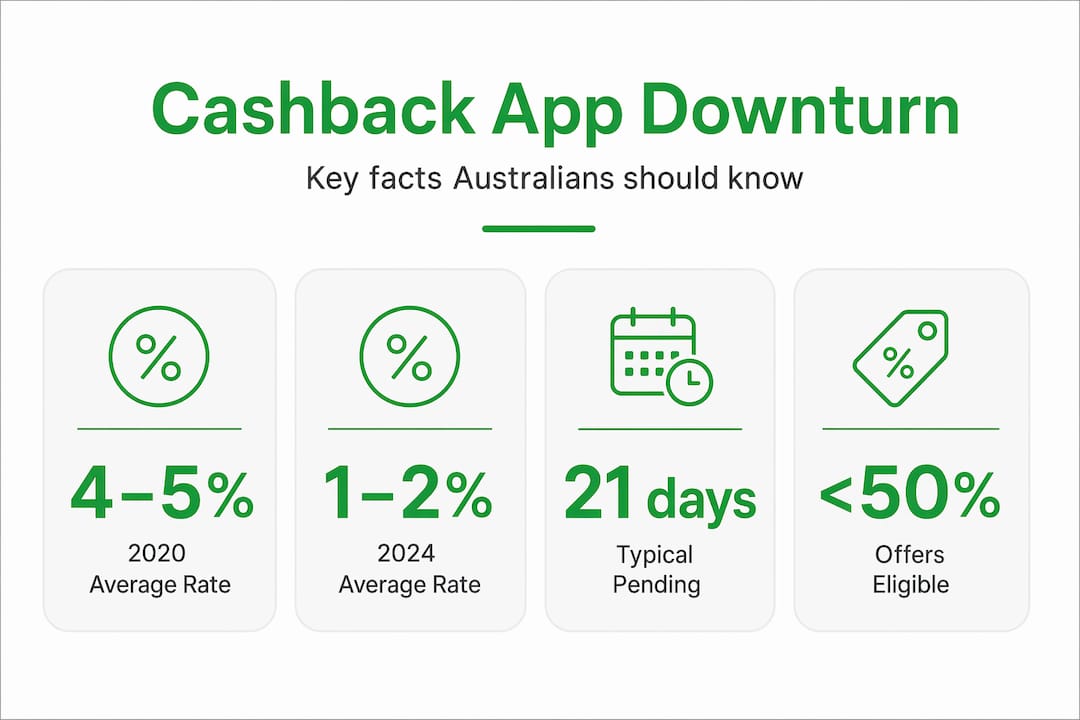
| Cashback rates are shrinking | Average rates dropped from 4–5% in 2020 to just 1–2% by 2025, reducing real-world value. |
| Exclusions catch users off guard | Many purchases, categories, and payment types simply don't qualify for cashback rewards. |
| Spending behaviour is the real risk | Chasing cashback often leads to buying things you wouldn't otherwise need. |
| Redemption delays frustrate users | Pending periods and minimum thresholds lock your money in the app for weeks or months. |
| Alternatives can outperform cashback | Membership discount clubs and direct offers often deliver more consistent, predictable savings. |
Why cashback apps fall short: the business model explained
To understand the cashback app limitations, you need to understand who actually pays for the rewards. These apps function as customer acquisition channels; retailers pay commissions as a marketing cost, and the app keeps a portion before passing a fraction on to you. The user gets the smallest slice of that arrangement.
Here's how the money moves:
- A retailer agrees to pay the cashback platform a commission, typically 5–15% of the sale value.
- The platform keeps a significant portion to cover operating costs and profit.
- The remaining amount, often 1–5%, is credited to the user's account.
- That credit sits in a pending state until the retailer confirms the transaction.
The commission split matters because retailers prefer cashback apps integrated directly with payment methods, as these provide clearer attribution and purchasing influence. Apps that rely on receipt scanning or browser extensions are considered less reliable by retailers, which affects the commissions they're willing to pay. Lower commissions mean lower cashback rates for you.
Redemption minimums add another layer of friction. Minimum thresholds and pending delays reduce the practical usability of cashback earnings, particularly for occasional shoppers who may take six months or longer to accumulate enough to withdraw. Your money is essentially sitting idle in someone else's system.
Pro Tip: Before signing up for any cashback platform, check the minimum withdrawal amount and the average pending period. If you need to accumulate $20 before withdrawing and each transaction takes 60 days to clear, your real return timeline is far longer than the advertised rate suggests.
Common exclusions that limit your earnings
Even when you do everything right, the fine print can still cancel your cashback. This is one of the most consistent issues with cashback apps, and it catches users off guard regularly.
Typical exclusions include balance transfers, cash advances, and certain person-to-person payment types. But the list goes further than that:
- Gift card purchases are excluded by most platforms, even when bought from a participating retailer.
- Sale items or already-discounted products often fall outside the eligible offer window.
- Specific product categories such as groceries, fuel, and pharmacy items are frequently restricted.
- Payments made via PayPal or buy-now-pay-later services like Afterpay may not trigger cashback at all.
- Rewards that expire if you don't log in or transact within a set period.
Brandon Strauss, VP at Shopkick, advises checking offer parameters carefully before making a purchase, noting that consumers regularly miss out on expected rewards simply by not reading the terms. That advice sounds obvious, but the exclusions are often buried several screens deep in the app.
The practical result is that your effective cashback rate on a typical month of shopping is often much lower than the headline rate advertised. A platform promoting "up to 10% cashback" may only apply that rate to one or two premium partner categories, while your everyday spending earns 0.5% or nothing at all.

Pro Tip: Screenshot the offer terms before completing a purchase. If the cashback doesn't appear within the expected window, you'll have evidence to support a dispute with the platform's support team.
Why cashback rates have been declining
The numbers tell a clear story. Average cashback rates dropped from 4–5% in 2020 to just 1–2% by 2025, with many mid-size apps shutting down or significantly reducing their offer catalogues. This isn't a coincidence. Several market forces are pushing rates down simultaneously.
| Factor | Impact on cashback rates |
|---|---|
| Tighter retail margins post-pandemic | Retailers reduced commissions to protect profitability |
| End of venture capital subsidies | Apps can no longer afford to offer artificially high rates |
| Data privacy law changes | Reduced ability to monetise user data, shrinking app revenue |
| Market saturation | More apps competing for the same commissions drives rates lower |
| Platform consolidation | Fewer apps, less competition, less incentive to offer generous rates |
"The cashback model was always more about customer acquisition for retailers than genuine savings for consumers. When the economics tightened, users felt it first." - VISU Network analysis on the cashback sector, 2025.
The data privacy angle is worth understanding. Cashback apps collect extensive user data which is monetised, but changes to Australian privacy law and third-party cookie deprecation have made that data harder to sell. When apps lose that secondary revenue stream, they compensate by offering users less.
The result is a shrinking model. The apps that remain are consolidating around the largest retailers and highest-margin categories, leaving everyday shoppers with fewer qualifying offers and lower rates than they experienced even three years ago.
Behavioural pitfalls of chasing cashback
Here's the problem that rarely appears in cashback app reviews: the reward structure is designed to change your spending behaviour, and not always in your favour.
When you open an app and see "8% cashback at a clothing retailer today only," you're being nudged toward a purchase you may not have planned. That's the entire point. Stores pay commissions as marketing costs with a guaranteed sales return on investment. You are the target of that marketing, and the cashback is the incentive to act.
The financial maths rarely works in the user's favour in these situations:
- Spending $150 on clothes you didn't need to earn $12 cashback is a net loss of $138.
- Buying a higher-priced item because it qualifies for cashback when a cheaper non-qualifying option exists costs more overall.
- Waiting for cashback to clear means your money is tied up, unavailable, and earning nothing.
There's also the psychological trap of feeling like you're "earning" when you're actually spending. The framing of cashback as income rather than a partial refund on discretionary spending distorts how people assess value. You haven't earned $12. You've spent $150 and recovered a fraction of it.
Pro Tip: Before any cashback purchase, ask yourself: "Would I buy this at full price with no cashback?" If the answer is no, the cashback offer is costing you money, not saving it.
⚠️ Tracking failures add another layer of risk. Browser cookies get blocked, app sessions time out, and retailer attribution systems fail. When that happens, your cashback simply doesn't appear, and the dispute process can take weeks with no guarantee of resolution.
Smarter alternatives to traditional cashback apps
If the shortcomings of cashback apps have you reconsidering your approach, you're not alone. A growing number of Australians are looking at savings models that don't depend on commission splits, retailer goodwill, or tracking technology.
The best rewards clubs in Australia work differently. Instead of returning a fraction of a retailer's marketing budget, they negotiate direct discounts for members, which means the savings are fixed, predictable, and don't expire in a pending queue.
| Savings method | How it works | Reliability |
|---|---|---|
| Cashback apps | Commission split returned after confirmation | Variable, often delayed |
| Membership discount clubs | Pre-negotiated rates for members | Consistent and immediate |
| Direct retailer loyalty programmes | Points or discounts tied to retailer's own system | Reliable but limited to one brand |
| Cashback credit cards | Bank-issued rewards on card spend | Reliable, but annual fees apply |
Loyalty programmes with strong ROI are built around repeat customer value rather than one-time acquisition. That's a fundamentally different incentive structure, and it tends to benefit the member more consistently over time.
The practical advice is to use cashback apps selectively, not as your primary savings strategy. They can add marginal value on large planned purchases where you've already confirmed eligibility. But as an everyday savings tool, the cashback app drawbacks outweigh the returns for most Australian households.
My honest take after testing these apps
I've spent time working through the major cashback platforms available to Australians, and the pattern is consistent. The onboarding experience is polished, the advertised rates look attractive, and then reality sets in.
In my experience, the first frustration arrives within the first month. A purchase doesn't track. A category you assumed was eligible turns out to be excluded. The minimum withdrawal threshold means your balance sits at $7.40 for weeks. By the time you accumulate enough to withdraw, the effort-to-return ratio feels genuinely poor.
What I've found is that the apps which work best are the ones you use rarely and deliberately, not constantly. If you're buying a laptop or booking a hotel and the cashback platform has a verified offer with clear terms, it's worth activating. For weekly grocery runs or fuel, the problems with cashback services consistently outweigh the benefit.
The uncomfortable truth is that these platforms are optimised for retailer outcomes, not yours. The economics clearly favour stores over shoppers. Once you see that clearly, you stop chasing the headline rate and start asking whether the model actually serves your financial goals. For most Australians, it doesn't, at least not as a standalone strategy.
- Victor
A different approach with Roopon
If you've recognised the cashback app user experience isn't delivering what it promised, Roopon offers a model worth understanding. Rather than returning a fraction of a retailer's commission weeks after the fact, Roopon gives members access to exclusive 'mates rates' across more than 16 partner stores, with savings that apply immediately at the point of purchase.

Members also receive FREE included prize-draw entries per their plan and published campaign terms. Extra packages exist for specific campaigns. Current prizes: roopon.com/giveaways. There are no pending queues, no minimum withdrawal thresholds, and no tracking cookies that can fail. Whether you're a uni student watching every dollar or a teacher looking for smarter savings, Roopon's membership tiers are built around real, consistent value. Explore how Roopon compares to cashback apps and see whether a savings club model suits you better.
FAQ
Why do cashback apps often pay less than advertised?
Cashback rates are calculated on a commission split between the retailer, the platform, and the user. Exclusions, category restrictions, and tracking failures frequently reduce the actual amount credited to your account below the headline rate.
Are cashback apps worth it for everyday Australian shopping?
For most everyday purchases, the cashback app drawbacks, including low rates, exclusions, and pending delays, mean the returns are minimal. They work best for large, planned purchases where you've confirmed eligibility in advance.
Why have cashback rates declined so much since 2020?
Average rates dropped from 4–5% in 2020 to 1–2% by 2025 due to tighter retail margins, the end of venture capital subsidies, and reduced ability to monetise user data under stricter privacy rules.
What are the biggest risks of using cashback apps?
The main risks include overspending to chase rewards, tracking failures that result in missing cashback, data privacy concerns from extensive data collection, and money sitting idle in pending accounts for extended periods.
What should I check before using a cashback offer?
Always verify the eligible product categories, payment method restrictions, minimum withdrawal threshold, and the pending clearance period before completing a purchase to avoid the most common cashback offer pitfalls.
